Category: Your Mind

How to Transform Your Life in 6 Minutes a Day

Minute 1: S is for silence.

Instead of hitting the snooze button, and then rushing through your day feeling stressed and overwhelmed, invest your first minute in sitting in purposeful silence. Sit quietly, calm and peaceful and breathe deeply. Maybe you meditate. Center yourself and create an optimum state of mind that will lead you effectively through the rest of your day.

Maybe you say a prayer of gratitude and appreciate the moment. As you sit in silence, you quiet your mind, relax your body and allow your stress to melt away. You develop a deeper sense of clarity, purpose, and direction.

Minute 2: A is for Affirmations.

Pull out and read your page of affirmations — written statements that remind you of your unlimited potential, your most important goals and the actions you must take today to achieve them. Reading over reminders of how capable you really are motivates you. Looking over which actions you must take, re-energizes you to focus on doing what’s necessary today to takeyour life to the next level.

Minute 3. V is for visualization.

Close your eyes and visualize what it will look like and feel like when you reach your goals. Seeing your ideal vision increases your belief that it’s possible and your desire to make it a reality.

Minute 4. E is for exercise.

Stand up and move your body for 60 seconds, long enough to increase the flow of blood and oxygen to your brain. You could easily do a minute of jumping jacks, push-ups, or sit-ups. The point is that you raise your heart rate, generate energy and increase your ability to be alert and focused.

Minute 5. R is for reading.

Grab the self-help book you’re currently reading and read one page, maybe two. Learn a new idea, something you can incorporate into your day, which will improve your results at work or in your relationships. Discover something new that you can use to think better, feel better and live better.

Minute 6. S is for scribing.

Pull out your journal and take one minute to write down something you’re grateful for, something you’re proud of and the top one to three results that you’re committed to creating that day. In doing so, you create the clarity and motivation that you need to take action.

Start today.

How would you feel if that’s how you used the first six minutes of each day? How would the quality of your day — and your life — improve? We can all agree that investing a minimum of six minutes into becoming the person that we need to be to create the lives we truly want is not only reasonable. It’s an absolute must.

10 Truths We Forget Too Easily

10 Truths We Forget Too Easily

Image credit: Cactusbeetroot | Flickr

Some of life’s essential truths need repeating. Keep this list handy and give it a read any time you need a boost.

1. Being Busy Does Not Equal Being Productive

Look at everyone around you. They all seem so busy—running from meeting to meeting and firing off emails. Yet how many of them are really producing, really succeeding at a high level?

Success doesn’t come from movement and activity. It comes from focus—from ensuring that your time is used efficiently and productively.

You get the same number of hours in the day as everyone else. Use yours wisely. After all, you’re the product of your output, not your effort. Make certain your efforts are dedicated to tasks that get results.

Related: How Successful People Stay Productive and In Control

2. Great Success Is Often Preceded By Failure

You will never experience true success until you learn to embrace failure. Your mistakes pave the way for you to succeed by revealing when you’re on the wrong path.

The biggest breakthroughs typically come when you’re feeling the most frustrated and the most stuck. It’s this frustration that forces you to think differently, to look outside the box and see the solution that you’ve been missing.

Success takes patience and the ability to maintain a good attitude even while suffering for what you believe in.

3. Fear Is the No. 1 Source of Regret

When it’s all said and done, you will lament the chances you didn’t take far more than you will your failures. Don’t be afraid to take risks.

I often hear people say, “What’s the worst thing that can happen to you? Will it kill you?” Yet, death isn’t the worst thing that can happen to you.

The worst thing that can happen to you is allowing yourself to die inside while you’re still alive.

4. Your Self-Worth Must Come From Within

When your sense of pleasure and satisfaction are derived from comparing yourself to others, you are no longer the master of your own destiny. When you feel good about something that you’ve done, don’t allow anyone’s opinions or accomplishments to take that away from you.

While it’s impossible to turn off your reactions to what others think of you, you don’t have to compare yourself to others, and you can always take people’s opinions with a grain of salt. That way, no matter what other people are thinking or doing, your self-worth comes from within. Regardless of what people think of you at any particular moment, one thing is certain—you’re never as good or bad as they say you are.

5. You’re Only as Good as Those You Associate With

You should strive to surround yourself with people who inspire you, people who make you want to be better. And you probably do. But what about the people who drag you down? Why do you allow them to be a part of your life?

Anyone who makes you feel worthless, anxious, or uninspired is wasting your time and, quite possibly, making you more like them. Life is too short to associate with people like this. Cut them loose.

6. Life Is Short

None of us are guaranteed a tomorrow. Yet, when someone dies unexpectedly it causes us to take stock of our own life: what’s really important, how we spend our time, and how we treat other people.

Loss is a raw, visceral reminder of the frailty of life. It shouldn’t be.

Remind yourself every morning when you wake up that each day is a gift and you’re bound to make the most of the blessing you’ve been given. The moment you start acting like life is a blessing is the moment it will start acting like one.

After all, a great day begins with a great mindset.

Related: Why Leaders Lack Emotional Intelligence

7. You Don’t Have to Wait for an Apology to Forgive

Life goes a lot smoother once you let go of grudges and forgive even those who never said they were sorry. Grudges let negative events from your past ruin today’s happiness. Hate and anger are emotional parasites that destroy your joy in life.

The negative emotions that come with holding on to a grudge create a stress response in your body, and holding on to stress can have devastating health consequences. Researchers at Emory University have shown that holding on to stress contributes to high blood pressure and heart disease.

When you forgive someone, it doesn’t condone their actions; it simply frees you from being their eternal victim.

8. You’re Living the Life You’ve Created

You are not a victim of circumstance. No one can force you to make decisions and take actions that run contrary to your values and aspirations.

The circumstances you’re living in today are your own—you created them. Likewise, your future is entirely up to you. If you’re feeling stuck, it’s probably because you’re afraid to take the risks necessary to achieve your goals and live your dreams.

When it’s time to take action, remember that it’s always better to be at the bottom of the ladder you want to climb than at the top of one you don’t.

9. Live in the Moment

You can’t reach your full potential until you learn to live your life in the present.

No amount of guilt can change the past, and no amount of anxiety can change the future. It’s impossible to be happy if you’re constantly somewhere else, unable to fully embrace the reality (good or bad) of this very moment.

To help yourself live in the moment, you must do two things:

  1. Accept your past. If you don’t make peace with your past, it will never leave you and, in doing so, it will create your future.
  2. Accept the uncertainty of the future. Worry has no place in the here and now. As Mark Twain once said, “Worrying is like paying a debt you don’t owe.”

10. Change Is Inevitable — Embrace It

Only when you embrace change can you find the good in it. You need to have an open mind and open arms if you’re going to recognize, and capitalize on, the opportunities that change creates.

You’re bound to fail when you keep doing the same things you always have in the hope that ignoring change will make it go away.

After all, the definition of insanity is doing the same thing over and over again and expecting a different result.

Life doesn’t stop for anyone. When things are going well, appreciate them and enjoy them, as they are bound to change. If you are always searching for something more, something better, that you think is going to make you happy, you’ll never be present enough to enjoy the great moments before they’re gone.

A version of this article first appeared on TalentSmart.com.

Top 10 Unsolved Mysteries of Science

Photo credit: NASA, ESA, CFHT, CXO, M.J. Jee (University of California, Davis), and A. Mahdavi (San Francisco State University)

Despite what cable news may tell you, scientists don’t really squabble over if evolution is real (it is) or if the climate is changing faster than can be explained by naturally-occurring phenomena (it is) or if vaccines are regarded as safe and recommended for most children (they are). Sure, there may be fine points within those categories that are debatable, but not to the extent that is commonly described by talking heads on TV. However, that’s not to say that scientists perfectly understand everything about the ways of the Universe.

Physicist Brian Cox once said: “I’m comfortable with the unknown—that’s the point of science. There are places out there, billions of places out there, that we know nothing about. And the fact that we know nothing about them excites me, and I want to go out and find out about them. And that’s what science is. So I think if you’re not comfortable with the unknown, then it’s difficult to be a scientist… I don’t need an answer. I don’t need answers to everything. I want to have answers to find.”

So what are some of the top mysteries keeping scientists busy? Here’s our top ten:

Why is there more matter than antimatter?

According to our current understanding of particle physics, matter and antimatter are equal but opposite. When they meet, they should destroy one another and leave nothing left over, and most of those annihilations should have occurred early in the Universe. However, there was enough matter left over to make the billions and billions of galaxies, stars, planets, and everything else. Various explanations surround mesons, which are short-lived subatomic particles made of one quark and one antiquark. B-mesons decay more slowly than anti-B-mesons, which could have resulted in enough B-mesons surviving the interaction to create all of the matter in the Universe. Additionally, B-, D-, and K-mesons can oscillate and become antiparticles and then back again. Studies have suggested that mesons are more likely to assume the normal state, which may also be why regular particles outnumber antiparticles.

Where is all the lithium?

Early in the Universe when temperatures were incredibly high, isotopes of hydrogen, helium, and lithium were synthesized in abundance. Hydrogen and helium are still incredibly abundant and make up nearly all of the mass in the Universe, though there is only about a third of the lithium-7 that we should see. There are a wide variety of explanations for why this might have happened, including some hypotheses involving hypothetical bosons known as axions, and others believe it is trapped in the core of stars, which our current telescopes and instruments can’t detect. However, there are currently no clear front running theories to explain this absence of lithium in the Universe.

Why do we sleep?

While we do know that the human body is regulated by a circadian clock that keeps humans on a sleep/wake cycle, we don’t really know why. Sleep is the time when our bodies repair tissues and perform other maintenance activities, and we spend nearly a third of our lives snoozing. Some other organisms don’t need to sleep at all, so why do we? There are a few different ideas out there, but none seem to solidly answer the question. Some theorize that animals who are able to sleep have evolved the ability to hide from predators, while others who need to remain more alert are able to rest and regenerate in other ways without fully going to sleep. While scientists don’t quite know why we do it, they are starting to learn more about why it is important, and how sleep impacts important things like brain plasticity.

How does gravity work?

We all know that gravity from the moon causes tides, Earth’s gravity holds us to the surface, and the sun’s gravity keeps our planet in orbit, but how much do we really understand it? This powerful force is generated from matter, and more massive objects therefore have a greater ability to attract other objects. While scientists do understand a great deal about how gravity acts, they aren’t really sure why it exists. Why are atoms mostly empty space? Why is the force that holds atoms together different from gravity? Is gravity actually a particle? These are answers that we really just can’t answer with our current understand of physics.

Where is everyone?

The observable Universe is 92 billion light-years in diameter, filled with billions of galaxies with stars and planets, yet the only evidence of any life anywhere is right here on Earth. Statistically, the odds of us actually being the only living beings in the Universe are impossibly low, so why the hell haven’t we connected with anyone else yet? This is known as the Fermi Paradox, and there have been dozens of suggestions to explain why we haven’t encountered extraterrestrial life; some more plausible than others. We could probably talk about all of the different possibilities for days about whether or not we’re just missing signals, if they’ve actually been here and we didn’t know it, they can’t/don’t want to talk to us, or—the extremely unlikely scenario—if Earth is the only planet with life ever.

What is dark matter made of?

About 80% of all mass in the Universe is made of dark matter. Dark matter is pretty peculiar stuff, as it doesn’t emit any light. Though it was first theorized about 60 years ago, there isn’t any direct evidence of its existence. Many scientists believe dark matter is comprised of weakly interacting massive particles (WIMPs), which could be up to 100 times more massive than a proton, but doesn’t readily interact with the baryonic matter our instruments were designed to detect. Other candidates for dark matter’s composition include axions, neutralinos, and photinos.

How did life begin?

Where did life on Earth come from? How did it happen? Those who believe in the Primordial Soup model believe that a nutrient-rich early Earth eventually formed increasingly-complex molecules that gave rise to life. This could have taken place in the deep ocean vents, in clay, or under ice. Different models also give variable levels of importance to the presence of lightning or volcanic activity for the spawn of life. While DNA is the predominant basis for life on Earth now, it has been suggested that RNA could have dominated the first lifeforms. Additionally, other scientists question whether other nucleic acids aside from RNA or DNA may have once existed. Did life spawn just once, or is it possible that is was created, wiped out, and then restarted? Some believe in panspermia, in which microbial life was brought to Earth via meteorites or comets. Even if that is true, it doesn’t answer the question of how that life originated.

How do plate tectonics work?

It might sound surprising, but the theory of continental plates moving around, rearranging continents and causing earthquakes, volcanic eruptions, and even forming mountains, has only received widespread support relatively recently. Though it was first postulated back around 1500 that the continents may have once fit together (it’s not really a stretch for anyone who has looked at a map), the idea didn’t gain a lot of traction until the 1960s when the hypothesis of sea-floor spreading, where rocks are pulled into the mantle of the Earth, recycled, and brought back to the surface as magma, was backed up by physical evidence. However, scientists aren’t entirely sure on what drives this movement or exactly how plate boundaries were created. There are many theories, but none of them completely address all aspects of this activity.

How do animals migrate?

Many animals and insects migrate throughout the year in order to escape changing seasonal temperatures and the waning resources that come with it or to find mates. Some of these migrations can reach thousands of kilometers in one direction, so how do they find their way there and back again year after year? Different animals use different navigational tools, including some who are able to tap into the Earth’s magnetic field and use themselves like a compass. However, scientists still don’t know how this trait evolved or how untrained animals know exactly where to go season after season.

What is dark energy?

Of all of the great mysteries of science, dark energy might be the most enigmatic of all. While dark matter makes up an estimated 80% of all mass, dark energy is a hypothetical form of energy believed to make up around 70% of all content in the Universe. Dark energy has been implicated as the cause for the expansion of the Universe, though there is still a considerable amount of mystery regarding its supposed properties. First and foremost, what is it even made of? Is dark energy constant, or are there fluctuations throughout the expanse of space? Why does dark energy’s density appear to match the density of regular matter? Can dark energy be reconciled with Einstein’s theory of gravity, or does the theory need to be reevaluated?

June 25, 2014 | by Lisa Winter

22 Ageless Life Lessons Everyone Can Learn From Aristotle

When you see the names Aristotle, Socrates, and Plato, what’s the first thing that comes to mind? Probably just a bunch of old dudes who don’t really have any bearing in your life. You’ve probably asked yourself, “what can I really learn from someone who lived 2,300 years ago?”

In all honesty, the life lessons from these great men are timeless. They apply to our everyday lives in way most people don’t even comprehend. These men were some of the most wisest men to walk the Earth. Below you will find 22 ageless life lessons everyone can learn from Aristotle… don’t forget to read some life changing lessons from Socrates as well!

1. “Knowing yourself is the beginning of all wisdom.”
2. “It is the mark of an educated mind to be able to entertain a thought without accepting it.”
3. “Patience is bitter, but its fruit is sweet.”
4. “Pleasure in the job puts perfection in the work.”
5. “It is during our darkest moments that we must focus to see the light.”
6. “To avoid criticism say nothing, do nothing, be nothing.”
7. “Excellence is never an accident. It is always the result of high intention, sincere effort, and intelligent execution; it represents the wise choice of many alternatives – choice, not chance, determines your destiny.”
8. “The wise man does not expose himself needlessly to danger, since there are few things for which he cares sufficiently; but he is willing, in great crises, to give even his life – knowing that under certain conditions it is not worthwhile to live.”
9. “There is no great genius without a mixture of madness.”
10. “The young are permanently in a state resembling intoxication.”
11. “We become just by performing just action, temperate by performing temperate actions, brave by performing brave action.”
12. “The worst form of inequality is to try to make unequal things equal.”
13. “Those that know, do. Those that understand, teach.”
14. “To run away from trouble is a form of cowardice and, while it is true that the suicide braves death, he does it not for some noble object but to escape some ill.”
15. “We are what we repeatedly do. Excellence, then, is not an act, but a habit.”
16. “We must no more ask whether the soul and body are one than ask whether the wax and the figure impressed on it are one.”
17. “We praise a man who feels angry on the right grounds and against the right persons and also in the right manner at the right moment and for the right length of time.”
18. “You will never do anything in this world without courage. It is the greatest quality of the mind next to honor.”
19. “Youth is easily deceived because it is quick to hope.”
20. “What it lies in our power to do, it lies in our power not to do.”
21. “Whosoever is delighted in solitude is either a wild beast or a god.”
22. “Without friends no one would choose to live, though he had all other goods.”

10 Things You Need To Eliminate From Your Life Immediately


1. Negative people.

I think it’s important to keep people in your life who hold your feet to the fire and want to see you achieve your dreams and be the best person you can be. There’s a solid difference between those kinds of people and negative people. Negative people think you’ll fail because they don’t trust you. Negative people don’t even really want you to succeed.

2. Caring about your mistakes.

Learning from your mistakes is crucial for growing and preventing those mistakes in the future, but don’t get hung up on it.

3. Worrying about the past.

Similar to caring about your mistakes, don’t sweat the past. It happened. You can’t go back in time.

4. Your self image.

I used to have real self image problems, but I didn’t fix it by forcing a more positive image on myself. I just stopped having a self image. It’s been incredible. I just don’t care anymore. Leads to some interesting outfits, sure, but life is way more relaxed.

5. Feeling sorry.

If you find yourself apologizing over things you shouldn’t be apologizing for, just knock it off. You’re brainwashing yourself into believing a false reality where you’re always at fault. You aren’t. Quit with the sorry.

6. Saying yes.

If you don’t want to. Don’t be weak in the face of the hard ask. Just say no if you don’t want to.

7. Trying to impress everyone.

You’re probably just fine how you are. No need to dress to impress.

8. Saying what people want to hear.

Hey, be honest. If you have something to say, say it. There’s no need to sugar coat your thoughts and feelings. Be out there, out loud, and real with people. They’ll respect you for it.

9. Your limiting beliefs.

One thing that tends to derail me is the belief that now isn’t the right time. Now is now, and the best time to start anything you want to do is at this moment. Don’t let core beliefs slow you down. They’re here to lift you up, not hold you down.

10. Worrying about the future.

The future is coming one way or the other. Be ready for it, but don’t spend your time in worry about it. It won’t do you any good at all.


May 3, 2015

Your Gut Feeling: Fear or Intuition

2015-02-12-Fearorintuition.png

At the very end of our almost 2.5-hour deep coaching conversation, my client asked me this: “How do I know when to trust my intuition and when to disregard it?”

She’d had several situations where she’d had a negative gut feeling about a situation, ignored it and later found that ignoring the feeling was the best thing she could have done.

Basically she wondered: Why would I trust my intuition when it’s so often wrong?

Now that’s an interesting question, because I believe intuition is never wrong. So what was going on here?

Suddenly I realized the problem: She wasn’t experiencing intuition, but fear.

And then, obviously, she asked me: “But if that’s true, how do I know when my gut feeling is fear and when it’s intuition?”

Yep. Great question.

Even though I know how I distinguish between fear and intuition, I didn’t have a set of concrete tips handy to offer her in the few minutes that we had left.

So I owe her an answer, and because I guess she and I may not be the only ones who are not absolutely sure how to distinguish a gut feeling based in fear, from a gut feeling based in intuition, I decided to write about it here.

What is Intuition?

Let’s first start with the basics. “Intuition” is such a buzzword that almost everyone has their own personal definition of what intuition is.

I did some research online, and found this straightforward definition:

“Intuition is the ability to understand something instinctively, without the need for conscious reasoning.”

And I think this is partly true, but intuition is more then just instinctive. There’s more to it then the instinctive urge to run from danger or to have food and water.

Even though I agree that intuition doesn’t need conscious reasoning, I believe it is not without cognitive elements. It’s more consideration than reasoning though. Intuition uses past knowledge and experiences to assess a situation, as well as a very quick assessment of the present, based on clues and details that may not be obvious to the rational mind, but are definitely there.

My definition of intuition is:

Intuition is a subconscious assessment of various elements:

  • the past (e.g. experiences, knowledge),
  • personal needs and preferences (e.g. how do I want to feel) and
  • the present (e.g. feelings that arise, choice of words, surroundings and signs other people are giving),

leading to a calculation of the best way to handle a situation.

I basically see intuition as a knowing that is based on more, rather then different elements than the rational mind can deal with at one given moment.

Is it Fear or Intuition?

Fear and intuition are easily confused, and that has to do with the fact that they are both experienced as a “gut feeling” — and I mean that literally: a feeling in your gut area.

Many of us have fallen a little out of touch with our gut feelings, to put it mildly. We’re so occupied with our thoughts and intelligent reasoning, that it’s hard to understand what our gut means when it has a feeling.

There are ways to distinguish gut feelings based in fear from gut feelings that signal intuition. Here’s how:

The difference between Fear and Intuition

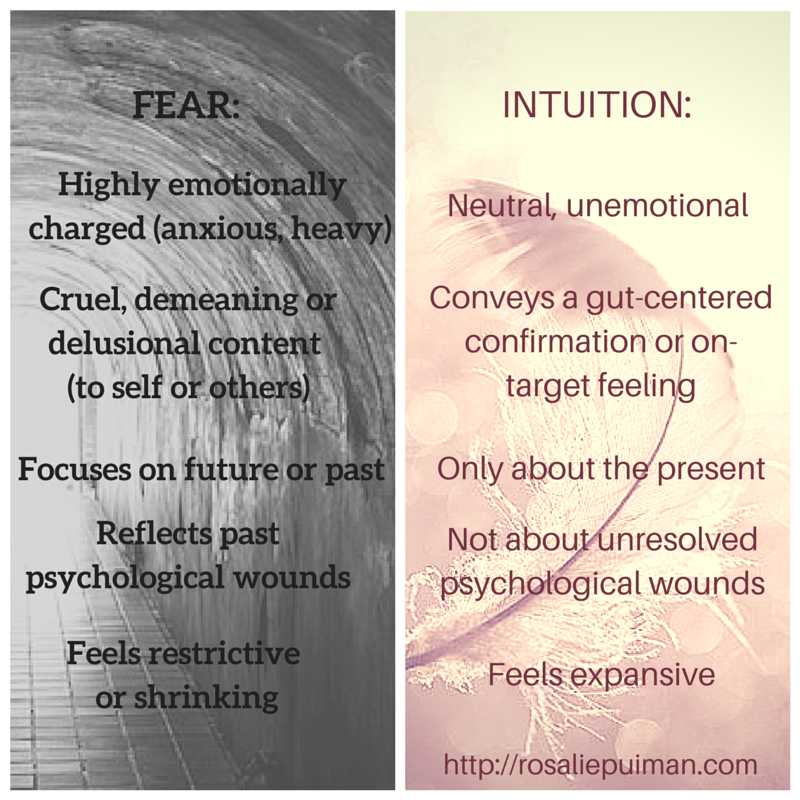
The two most important things that separate fear from intuition are
1) Intuition being only about the present. There’s NO worrying about past or future involved.
2) Intuition being neutral, unemotional, whereas fear is highly emotionally charged.

Reliable intuition feels right, it has a compassionate, affirming tone to it.
It confirms that you are on target, without having an overly positive or negative feel to it.
Fear is often anxious, dark or heavy. It has cruel, demeaning or delusional content (to yourself or to others) and it reflects unhealed psychological wounds.
2015-02-12-fearvsintuitionRosaliePuiman.png

How to distinguish Fear from Intuition

I have two practices to learn how to distinguish fear from intuition.
The first one is a little heavy, but very helpful: Make a list of everything you are afraid off. After that, it will be easier to recognize when a gut feeling is referring to one of your fears.

The second practice is from Christine Gutierrez:
Imagine a baby or pet you love — try to get a clear image in your head — and notice the feeling in your belly that goes with this picture. It will be expansive.

Then, imagine a destructive image, like failing to get your dream job, gaining lots of kilos or whatever gets you upset. Notice the feeling: it will be restrictive, shrinking.

Lastly, imagine a fearful feeling based on intuitive guidance, e.g. going to see a therapist to deal with the destructive feeling you just thought of, even though you’ve always been afraid to go into therapy.

Close your eyes, and experience BOTH the fear AND the underlying good feeling that indicates you know you are doing the right thing.

Practice feeling the difference between Fear and Intuition

It’s extremely powerful, and very handy, to know how to separate the gut feeling that you can (and should) trust immediately (intuition) from the one you should look at in compassion (fear). Getting to know the difference between fear and intuition takes practice and it is absolutely worth the effort.

On a side note: Fearful feelings can be interfering, but they are not all without use. Sometimes fear signals that moment just before you start something new. In that case, a gut feeling based in fear can be a signal for you to push on.

I would love to hear your thoughts on the topic of fear and intuition. Take a moment to add your voice to the discussion in the comments below.

Rosalie Puiman

The actual process of thinking ahead

I think that what separates us from any other species on earth is the simple fact that some of us, (probably most of us humans) can actually think ahead, Anticipating what might be a possible outcome for the actions we are taking at this point in time. It is truly amazing that at any given moment we can unconsciously decide the start of an outcome that creates a significant life changing event. It only takes a fraction of a second to change the direction of your entire life, and sometimes only based on a single moment’s emotion. So in fact, if you are not in control of your emotions on an ongoing basis, you could be harming or altering your future at that moment. And sometimes the consequences can last your entire lifetime.

In the moment that changes rational thinking, to a momentary lapse of reason could in fact be a side of you that is not normally you. A study being undertaken at this moment, is showing results that even shock me, and I am usually unshockable.  I thought I had seen and heard almost everything and at my ripe old age, and will happily listen to anything you have to say about this topic, so go ahead let me have it. There is a rational explanation for it, and it’s a mathematic formula. I respect science, (and I’m not even into scientology), but there is a mathematical equation for everything on the planet, all you have to do is find it, (work it out) and apply it, sometimes it takes years of preparing the proper delivery, but it can and must be done.

Let’s get into the core of the subject.

Thinking ahead is a good and a bad thing, it can prepare you for what’s in store, and it can jade you. As some of my colleagues that have a ‘You bring it on yourself’ attitude’, I call Bullshit ! What a cop out. I’ve seen where if you discuss a negative topic, you are fulfilling a ‘Manifest Destiny.’ and bring that result into your life. I am of the belief that you need to ‘Believe in yourself’ a small bit, or A LOT !! come on people we are NOT stupid, Why do we treat ourselves like we are Idiots ?

If you say something to a person and they respond with “don’t say that, you’ll create that in your life” maybe you just have a great intuition, and feel that it might be coming ! If you have a choice between who is right and who is wrong I strongly believe that you believe in yourself. Believe your Gut Feelings !! It may not be evident at the time but in the long run you will be the better for it. Choosing your weak premises and then being disappointed that you did not look into your soul for the answer will only leave you empty. Chose you. Whether you falter and learn, then move on, or win and move on, with a different attitude, you can’t loose.


admin cymantra.com

Study Reveals a Natural and Effective Way To Relieve Stress

Relieve StressAs a kid growing up when my family would visit my grandma would always bake oatmeal in the morning for breakfast with apples, raisins, and cinnamon on top. I always knew that she was baking this oatmeal because I could smell that rich apple cinnamon oat smell from anywhere! and it was delicious. Years later as I grew up I found out that cinnamon had much more of a use than tasting and smelling good.

Cinnamon naturally boosts cognitive function, memory, alertness and reduces the formation of certain neurodegenerative diseases such as Alzheimer’s according to the National Institutes Of Health. Not only that but check out the incredible range of cinnamon health benefits:

* Boosts Brainpower (Alertness, Cognitive Function and Dopamine Production)

* Reduces Neurodegenerative Disease Formation

* Curb’s Appetite (Improves Brain Chemistry Effectively Reducing Cravings)

 * Reduces Plaque Formation (Helps Teeth & Arteries/Heart Stay Healthy)

As well as numerous other benefits, but what I found really interesting and definitely worth sharing with you is a study done by Wheeling Jesuit University. They found that when cinnamon and peppermint were smelled together it reduced frustration, stress and helped drivers feel better and more alert on their morning commute to work.

Not only that, but there are many studies that show that peppermint enhances mental, athletic and cognitive performance as well as pain tolerance! They found that peppermint reduces the feeling of workload and general frustrations. Wheeling Jesuit university applied the study of these two cents to drivers on the roadway on their way to work, dealing with traffic and rush hour. They found that drivers were less frustrated, had less anxiety and fatigue, and were more alert.

Peppermint is uplifting, elevating your mood and making you feel happier while cinnamon is comforting but brings your energy down making you feel a bit slower in certain ways. This may be partially because it balances blood sugar levels and if your blood glucose levels are higher it will bring them down a bit, which can actually make you feel a bit more sedentary.

Both have positive effects but when paired together they are the ultimate pair of scents to smell on the way to work and even at work to be more productive, get more done and have less anxiety and frustration during that time. Not to mention that both of these scents, cinnamon and peppermint, enhance your cognitive function, memory and help you be more actively engaged, productive and smarter.

They both have positive effects especially when paired together. Just don’t go smelling cinnamon alone and go to the mall because some research has shown that the smell of cinnamon alone increases spending habits! According to a study led by Temple University and the Stevens Institute of Technology they found that smelling cinnamon which is a warming spice led to people feeling the room was more warm and crowded which led them to make more prestigious buying decisions. They explained the psychology behind this…

“People smelling warm fragrances such as cinnamon feel that the room they are in is more crowded, and feel less powerful as a result,” the authors write. “This can lead them to compensate by buying items they feel are more prestigious.”

So if you forget the peppermint somehow, give your partner or friend your credit card to hold for a few hours until it wears off! (or something to that affect)

The question now is, how do you smell cinnamon and peppermint in the morning before your work commute to make the drive and workday easier? I recommend getting a 2 ounce glass spray bottle (click here to see an example of this) and using essential oils.

unnamed

You can get CPTG (certified pure therapeutic grade, the highest quality) peppermint and cinnamon essential oils from doterra (click here to visit their website) and then you can simply put 8 drops of peppermint and 8 drops of cinnamon in this glass bottle. Fill the rest with water and then keep it in your car! You can use it on the way to work, on the way home, or even in the office. It’s a great destressing and brain enhancing mood elevating blend and you’ll still have the peppermint and cinnamon oils to use in other ways and benefit from. You can also use just cinnamon essential oil in these spray bottles and use that around your home if you have a fruit fly problem and it works well.

There you have it, smell some cinnamon and peppermint in the morning before your commute to work and you’ll be less stressed and have more brain power and productivity.

Please share this article if you enjoyed it!

P.S. Cinnamon is one of the oldest known spices used for food and medicine in the world! dating back 4,000 years in the bible as well as Chinese texts. It’s definitely a spice to include in your diet and have handy for the wide variety of benefits.

Article by David Benjamin

hwfDavid Benjamin is a holistic health blogger, podcaster and publisher. He writes and produces media related to diet, nutrition, health, fitness, green living, spirituality, sustainability and more. You can get a free book from him entitled “Your Supplements Suck” at HealthyWildAndFree.com. You can also follow for health updates and inspirational ideas on Facebook, and subscribe on Youtube.

Sources: BrainHQ.com, wju.edu, wju.edu, MedicalDaily.com, Image: flickr/tzofia