Category: Psychology

Top 10 Unsolved Mysteries of Science

Photo credit: NASA, ESA, CFHT, CXO, M.J. Jee (University of California, Davis), and A. Mahdavi (San Francisco State University)

Despite what cable news may tell you, scientists don’t really squabble over if evolution is real (it is) or if the climate is changing faster than can be explained by naturally-occurring phenomena (it is) or if vaccines are regarded as safe and recommended for most children (they are). Sure, there may be fine points within those categories that are debatable, but not to the extent that is commonly described by talking heads on TV. However, that’s not to say that scientists perfectly understand everything about the ways of the Universe.

Physicist Brian Cox once said: “I’m comfortable with the unknown—that’s the point of science. There are places out there, billions of places out there, that we know nothing about. And the fact that we know nothing about them excites me, and I want to go out and find out about them. And that’s what science is. So I think if you’re not comfortable with the unknown, then it’s difficult to be a scientist… I don’t need an answer. I don’t need answers to everything. I want to have answers to find.”

So what are some of the top mysteries keeping scientists busy? Here’s our top ten:

Why is there more matter than antimatter?

According to our current understanding of particle physics, matter and antimatter are equal but opposite. When they meet, they should destroy one another and leave nothing left over, and most of those annihilations should have occurred early in the Universe. However, there was enough matter left over to make the billions and billions of galaxies, stars, planets, and everything else. Various explanations surround mesons, which are short-lived subatomic particles made of one quark and one antiquark. B-mesons decay more slowly than anti-B-mesons, which could have resulted in enough B-mesons surviving the interaction to create all of the matter in the Universe. Additionally, B-, D-, and K-mesons can oscillate and become antiparticles and then back again. Studies have suggested that mesons are more likely to assume the normal state, which may also be why regular particles outnumber antiparticles.

Where is all the lithium?

Early in the Universe when temperatures were incredibly high, isotopes of hydrogen, helium, and lithium were synthesized in abundance. Hydrogen and helium are still incredibly abundant and make up nearly all of the mass in the Universe, though there is only about a third of the lithium-7 that we should see. There are a wide variety of explanations for why this might have happened, including some hypotheses involving hypothetical bosons known as axions, and others believe it is trapped in the core of stars, which our current telescopes and instruments can’t detect. However, there are currently no clear front running theories to explain this absence of lithium in the Universe.

Why do we sleep?

While we do know that the human body is regulated by a circadian clock that keeps humans on a sleep/wake cycle, we don’t really know why. Sleep is the time when our bodies repair tissues and perform other maintenance activities, and we spend nearly a third of our lives snoozing. Some other organisms don’t need to sleep at all, so why do we? There are a few different ideas out there, but none seem to solidly answer the question. Some theorize that animals who are able to sleep have evolved the ability to hide from predators, while others who need to remain more alert are able to rest and regenerate in other ways without fully going to sleep. While scientists don’t quite know why we do it, they are starting to learn more about why it is important, and how sleep impacts important things like brain plasticity.

How does gravity work?

We all know that gravity from the moon causes tides, Earth’s gravity holds us to the surface, and the sun’s gravity keeps our planet in orbit, but how much do we really understand it? This powerful force is generated from matter, and more massive objects therefore have a greater ability to attract other objects. While scientists do understand a great deal about how gravity acts, they aren’t really sure why it exists. Why are atoms mostly empty space? Why is the force that holds atoms together different from gravity? Is gravity actually a particle? These are answers that we really just can’t answer with our current understand of physics.

Where is everyone?

The observable Universe is 92 billion light-years in diameter, filled with billions of galaxies with stars and planets, yet the only evidence of any life anywhere is right here on Earth. Statistically, the odds of us actually being the only living beings in the Universe are impossibly low, so why the hell haven’t we connected with anyone else yet? This is known as the Fermi Paradox, and there have been dozens of suggestions to explain why we haven’t encountered extraterrestrial life; some more plausible than others. We could probably talk about all of the different possibilities for days about whether or not we’re just missing signals, if they’ve actually been here and we didn’t know it, they can’t/don’t want to talk to us, or—the extremely unlikely scenario—if Earth is the only planet with life ever.

What is dark matter made of?

About 80% of all mass in the Universe is made of dark matter. Dark matter is pretty peculiar stuff, as it doesn’t emit any light. Though it was first theorized about 60 years ago, there isn’t any direct evidence of its existence. Many scientists believe dark matter is comprised of weakly interacting massive particles (WIMPs), which could be up to 100 times more massive than a proton, but doesn’t readily interact with the baryonic matter our instruments were designed to detect. Other candidates for dark matter’s composition include axions, neutralinos, and photinos.

How did life begin?

Where did life on Earth come from? How did it happen? Those who believe in the Primordial Soup model believe that a nutrient-rich early Earth eventually formed increasingly-complex molecules that gave rise to life. This could have taken place in the deep ocean vents, in clay, or under ice. Different models also give variable levels of importance to the presence of lightning or volcanic activity for the spawn of life. While DNA is the predominant basis for life on Earth now, it has been suggested that RNA could have dominated the first lifeforms. Additionally, other scientists question whether other nucleic acids aside from RNA or DNA may have once existed. Did life spawn just once, or is it possible that is was created, wiped out, and then restarted? Some believe in panspermia, in which microbial life was brought to Earth via meteorites or comets. Even if that is true, it doesn’t answer the question of how that life originated.

How do plate tectonics work?

It might sound surprising, but the theory of continental plates moving around, rearranging continents and causing earthquakes, volcanic eruptions, and even forming mountains, has only received widespread support relatively recently. Though it was first postulated back around 1500 that the continents may have once fit together (it’s not really a stretch for anyone who has looked at a map), the idea didn’t gain a lot of traction until the 1960s when the hypothesis of sea-floor spreading, where rocks are pulled into the mantle of the Earth, recycled, and brought back to the surface as magma, was backed up by physical evidence. However, scientists aren’t entirely sure on what drives this movement or exactly how plate boundaries were created. There are many theories, but none of them completely address all aspects of this activity.

How do animals migrate?

Many animals and insects migrate throughout the year in order to escape changing seasonal temperatures and the waning resources that come with it or to find mates. Some of these migrations can reach thousands of kilometers in one direction, so how do they find their way there and back again year after year? Different animals use different navigational tools, including some who are able to tap into the Earth’s magnetic field and use themselves like a compass. However, scientists still don’t know how this trait evolved or how untrained animals know exactly where to go season after season.

What is dark energy?

Of all of the great mysteries of science, dark energy might be the most enigmatic of all. While dark matter makes up an estimated 80% of all mass, dark energy is a hypothetical form of energy believed to make up around 70% of all content in the Universe. Dark energy has been implicated as the cause for the expansion of the Universe, though there is still a considerable amount of mystery regarding its supposed properties. First and foremost, what is it even made of? Is dark energy constant, or are there fluctuations throughout the expanse of space? Why does dark energy’s density appear to match the density of regular matter? Can dark energy be reconciled with Einstein’s theory of gravity, or does the theory need to be reevaluated?

June 25, 2014 | by Lisa Winter

10 Things You Need To Eliminate From Your Life Immediately


1. Negative people.

I think it’s important to keep people in your life who hold your feet to the fire and want to see you achieve your dreams and be the best person you can be. There’s a solid difference between those kinds of people and negative people. Negative people think you’ll fail because they don’t trust you. Negative people don’t even really want you to succeed.

2. Caring about your mistakes.

Learning from your mistakes is crucial for growing and preventing those mistakes in the future, but don’t get hung up on it.

3. Worrying about the past.

Similar to caring about your mistakes, don’t sweat the past. It happened. You can’t go back in time.

4. Your self image.

I used to have real self image problems, but I didn’t fix it by forcing a more positive image on myself. I just stopped having a self image. It’s been incredible. I just don’t care anymore. Leads to some interesting outfits, sure, but life is way more relaxed.

5. Feeling sorry.

If you find yourself apologizing over things you shouldn’t be apologizing for, just knock it off. You’re brainwashing yourself into believing a false reality where you’re always at fault. You aren’t. Quit with the sorry.

6. Saying yes.

If you don’t want to. Don’t be weak in the face of the hard ask. Just say no if you don’t want to.

7. Trying to impress everyone.

You’re probably just fine how you are. No need to dress to impress.

8. Saying what people want to hear.

Hey, be honest. If you have something to say, say it. There’s no need to sugar coat your thoughts and feelings. Be out there, out loud, and real with people. They’ll respect you for it.

9. Your limiting beliefs.

One thing that tends to derail me is the belief that now isn’t the right time. Now is now, and the best time to start anything you want to do is at this moment. Don’t let core beliefs slow you down. They’re here to lift you up, not hold you down.

10. Worrying about the future.

The future is coming one way or the other. Be ready for it, but don’t spend your time in worry about it. It won’t do you any good at all.


May 3, 2015

Your Gut Feeling: Fear or Intuition

2015-02-12-Fearorintuition.png

At the very end of our almost 2.5-hour deep coaching conversation, my client asked me this: “How do I know when to trust my intuition and when to disregard it?”

She’d had several situations where she’d had a negative gut feeling about a situation, ignored it and later found that ignoring the feeling was the best thing she could have done.

Basically she wondered: Why would I trust my intuition when it’s so often wrong?

Now that’s an interesting question, because I believe intuition is never wrong. So what was going on here?

Suddenly I realized the problem: She wasn’t experiencing intuition, but fear.

And then, obviously, she asked me: “But if that’s true, how do I know when my gut feeling is fear and when it’s intuition?”

Yep. Great question.

Even though I know how I distinguish between fear and intuition, I didn’t have a set of concrete tips handy to offer her in the few minutes that we had left.

So I owe her an answer, and because I guess she and I may not be the only ones who are not absolutely sure how to distinguish a gut feeling based in fear, from a gut feeling based in intuition, I decided to write about it here.

What is Intuition?

Let’s first start with the basics. “Intuition” is such a buzzword that almost everyone has their own personal definition of what intuition is.

I did some research online, and found this straightforward definition:

“Intuition is the ability to understand something instinctively, without the need for conscious reasoning.”

And I think this is partly true, but intuition is more then just instinctive. There’s more to it then the instinctive urge to run from danger or to have food and water.

Even though I agree that intuition doesn’t need conscious reasoning, I believe it is not without cognitive elements. It’s more consideration than reasoning though. Intuition uses past knowledge and experiences to assess a situation, as well as a very quick assessment of the present, based on clues and details that may not be obvious to the rational mind, but are definitely there.

My definition of intuition is:

Intuition is a subconscious assessment of various elements:

  • the past (e.g. experiences, knowledge),
  • personal needs and preferences (e.g. how do I want to feel) and
  • the present (e.g. feelings that arise, choice of words, surroundings and signs other people are giving),

leading to a calculation of the best way to handle a situation.

I basically see intuition as a knowing that is based on more, rather then different elements than the rational mind can deal with at one given moment.

Is it Fear or Intuition?

Fear and intuition are easily confused, and that has to do with the fact that they are both experienced as a “gut feeling” — and I mean that literally: a feeling in your gut area.

Many of us have fallen a little out of touch with our gut feelings, to put it mildly. We’re so occupied with our thoughts and intelligent reasoning, that it’s hard to understand what our gut means when it has a feeling.

There are ways to distinguish gut feelings based in fear from gut feelings that signal intuition. Here’s how:

The difference between Fear and Intuition

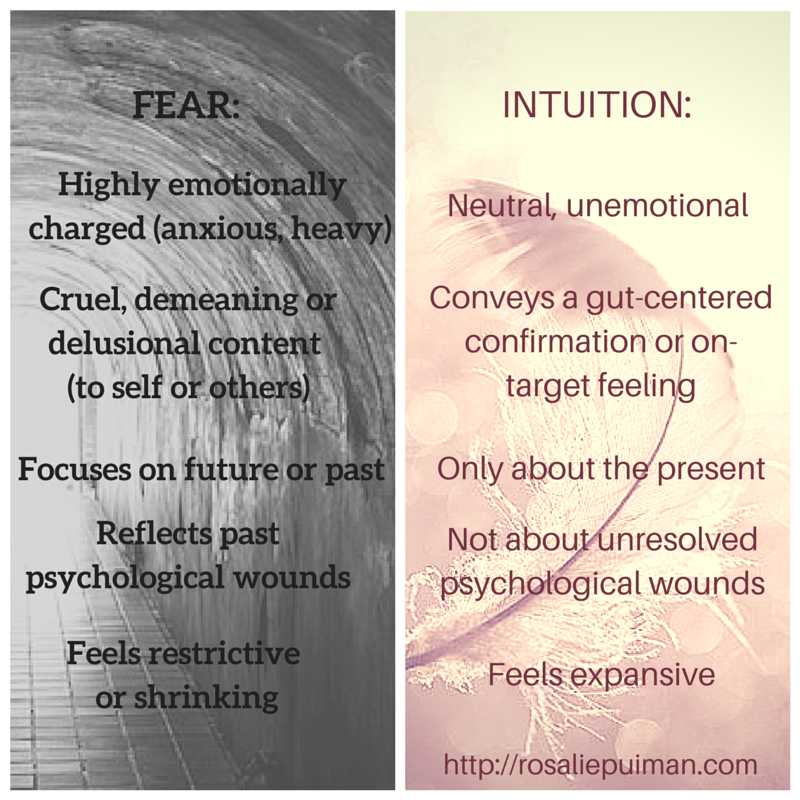
The two most important things that separate fear from intuition are
1) Intuition being only about the present. There’s NO worrying about past or future involved.
2) Intuition being neutral, unemotional, whereas fear is highly emotionally charged.

Reliable intuition feels right, it has a compassionate, affirming tone to it.
It confirms that you are on target, without having an overly positive or negative feel to it.
Fear is often anxious, dark or heavy. It has cruel, demeaning or delusional content (to yourself or to others) and it reflects unhealed psychological wounds.
2015-02-12-fearvsintuitionRosaliePuiman.png

How to distinguish Fear from Intuition

I have two practices to learn how to distinguish fear from intuition.
The first one is a little heavy, but very helpful: Make a list of everything you are afraid off. After that, it will be easier to recognize when a gut feeling is referring to one of your fears.

The second practice is from Christine Gutierrez:
Imagine a baby or pet you love — try to get a clear image in your head — and notice the feeling in your belly that goes with this picture. It will be expansive.

Then, imagine a destructive image, like failing to get your dream job, gaining lots of kilos or whatever gets you upset. Notice the feeling: it will be restrictive, shrinking.

Lastly, imagine a fearful feeling based on intuitive guidance, e.g. going to see a therapist to deal with the destructive feeling you just thought of, even though you’ve always been afraid to go into therapy.

Close your eyes, and experience BOTH the fear AND the underlying good feeling that indicates you know you are doing the right thing.

Practice feeling the difference between Fear and Intuition

It’s extremely powerful, and very handy, to know how to separate the gut feeling that you can (and should) trust immediately (intuition) from the one you should look at in compassion (fear). Getting to know the difference between fear and intuition takes practice and it is absolutely worth the effort.

On a side note: Fearful feelings can be interfering, but they are not all without use. Sometimes fear signals that moment just before you start something new. In that case, a gut feeling based in fear can be a signal for you to push on.

I would love to hear your thoughts on the topic of fear and intuition. Take a moment to add your voice to the discussion in the comments below.

Rosalie Puiman

The actual process of thinking ahead

I think that what separates us from any other species on earth is the simple fact that some of us, (probably most of us humans) can actually think ahead, Anticipating what might be a possible outcome for the actions we are taking at this point in time. It is truly amazing that at any given moment we can unconsciously decide the start of an outcome that creates a significant life changing event. It only takes a fraction of a second to change the direction of your entire life, and sometimes only based on a single moment’s emotion. So in fact, if you are not in control of your emotions on an ongoing basis, you could be harming or altering your future at that moment. And sometimes the consequences can last your entire lifetime.

In the moment that changes rational thinking, to a momentary lapse of reason could in fact be a side of you that is not normally you. A study being undertaken at this moment, is showing results that even shock me, and I am usually unshockable.  I thought I had seen and heard almost everything and at my ripe old age, and will happily listen to anything you have to say about this topic, so go ahead let me have it. There is a rational explanation for it, and it’s a mathematic formula. I respect science, (and I’m not even into scientology), but there is a mathematical equation for everything on the planet, all you have to do is find it, (work it out) and apply it, sometimes it takes years of preparing the proper delivery, but it can and must be done.

Let’s get into the core of the subject.

Thinking ahead is a good and a bad thing, it can prepare you for what’s in store, and it can jade you. As some of my colleagues that have a ‘You bring it on yourself’ attitude’, I call Bullshit ! What a cop out. I’ve seen where if you discuss a negative topic, you are fulfilling a ‘Manifest Destiny.’ and bring that result into your life. I am of the belief that you need to ‘Believe in yourself’ a small bit, or A LOT !! come on people we are NOT stupid, Why do we treat ourselves like we are Idiots ?

If you say something to a person and they respond with “don’t say that, you’ll create that in your life” maybe you just have a great intuition, and feel that it might be coming ! If you have a choice between who is right and who is wrong I strongly believe that you believe in yourself. Believe your Gut Feelings !! It may not be evident at the time but in the long run you will be the better for it. Choosing your weak premises and then being disappointed that you did not look into your soul for the answer will only leave you empty. Chose you. Whether you falter and learn, then move on, or win and move on, with a different attitude, you can’t loose.


admin cymantra.com